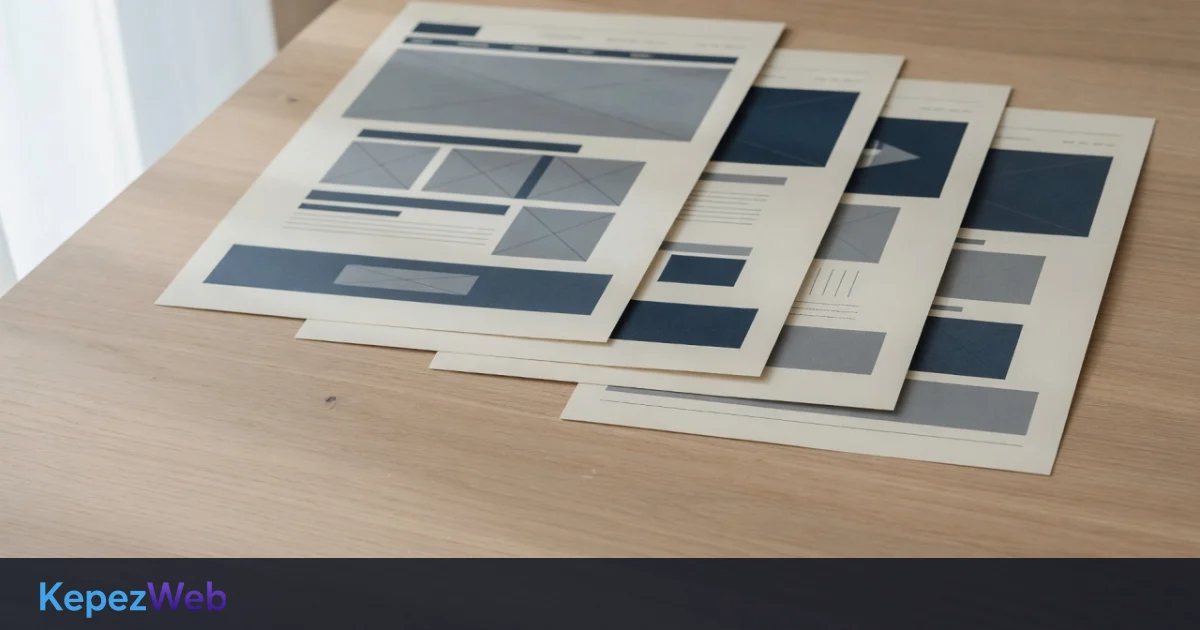
This template vs custom web design comparison explores costs, performance, SEO, flexibility and illustrative five-year total cost of ownership (TCO).
Template or custom web design? — This is a common dilemma when planning a website. The answer depends on your budget, long-term goals and how established your brand is. Here, we compare both approaches in terms of cost, performance, SEO, flexibility and five-year total cost of ownership (TCO).
What Is a Website Template?
A website template is a pre-designed, pre-coded layout purchased or downloaded from marketplaces such as ThemeForest or TemplateMonster, or from the WordPress.org repository. The same theme may be used by many websites, with content and colour changes providing basic personalisation.
What Is Custom Web Design?
Custom web design involves designing and developing a website specifically for your brand. The process includes UI/UX research, brand-aligned Figma designs and development using semantic HTML5 and modern CSS/JavaScript. The resulting codebase is tailored to the project.
Detailed Comparison Table
| Criterion | Website Template | Custom Web Design |
|---|---|---|
| Initial cost | Depends on licensing, setup and adaptation scope | Depends on analysis, design and development scope |
| Time to launch | Depends on content and theme adaptation | Depends on design approval and development scope |
| Customisation | Often limited by plugins or builders | Extensive flexibility within the agreed scope |
| Design originality | Shared layouts can make differentiation harder | Designed around the brand |
| Performance | Depends on the theme, modules and optimisation | Depends on code, content and infrastructure decisions |
| Core Web Vitals | Must be measured using real user data | Laboratory and field data must be measured separately |
| SEO foundations | Generic foundations may need additional configuration | Can be planned from the design stage |
| Security | Plugin-related vulnerability risk | Depends on code quality and disciplined maintenance |
| Scalability | May be constrained by the theme architecture | Can be designed for future growth |
| Ease of maintenance | Familiar tools, but plugin compatibility can be an issue | Can be simpler with a well-documented codebase |
| Copyright and ownership | Use is governed by the template licence | Ownership and usage rights depend on the contract |
| Five-year TCO | Depends on licensing, maintenance and possible redesigns | Depends on development, maintenance and possible redesigns |
Website Templates — Advantages and Disadvantages
Advantages
- Lower initial cost: Ready-made components can reduce the initial setup workload.
- Quick setup: Importing demo content can support a 3–7-day launch for a straightforward project, subject to content and testing.
- Ready-made demo: You can preview the design before choosing it.
- Community support: Popular themes often have active forums and documentation.
Disadvantages
- Limited differentiation: Many websites may use the same theme, making your brand harder to distinguish.
- Performance overhead: Some themes load CSS/JS for modules you do not use.
- Limited customisation: Requirements beyond a page builder’s capabilities may need custom code.
- Security vulnerabilities: Outdated plugins and unmaintained themes can create significant risks.
- SEO limitations: Bloated code and missing or incorrect schema markup may need attention.
- Maintenance demands: Keeping WordPress core, themes and plugins compatible requires ongoing work.
- Licence renewals: Check the update, support and licence renewal terms for themes and plugins.
Custom Web Design — Advantages and Disadvantages
Advantages
- Brand-specific UI/UX: An experience tailored to your audience, whether you run an Antalya hotel, villa rental business or service for expats.
- SEO foundations: Schema markup, Core Web Vitals considerations and mobile-first development can be built into the project.
- Speed: The site can be developed to load only the CSS/JS it needs.
- Scalability: The infrastructure can be planned to accommodate growing traffic.
- Security: A tailored codebase can reduce reliance on third-party plugins, but still needs security reviews and maintenance.
- Copyright and ownership: Ownership of code and design files should be clearly agreed in the contract.
- Longevity: The useful lifespan depends on infrastructure maintenance and changing requirements; updates must be planned separately.
Disadvantages
- Higher initial budget: Analysis, design and development effort determine the scope of the initial investment.
- Longer process: The schedule is determined by the scope of design, development and content approvals.
- Choosing the right agency matters: A poor fit can lead to costly rework.
Five-Year TCO (Total Cost of Ownership) Comparison
| Year | Website Template | Custom Web Design |
|---|---|---|
| Year 1 (setup and first year) | Setup, licensing and initial maintenance scope | Analysis, development and initial support scope |
| Year 2 | Licence renewals and content changes | Maintenance and update plan |
| Year 3 (major update) | Theme or structural redesign if needed | Maintenance and change requests |
| Year 4 | Licences and additional module requirements | Maintenance and change requests |
| Year 5 (rebuild) | Redesign and licences if needed | Interface refresh if needed |
| Five-Year Total | Project-specific total of all annual items | Project-specific total of all annual items |
Note: This table is not a price estimate; it is a framework for checking five-year cost items. Traffic and conversion effects can only be assessed through measurements made under the same conditions.
Comparing SEO Performance
When comparing templates with custom design, measure under the same device, network and content conditions:
- Template: Review the modules used, image load and third-party code.
- Custom design: Measure how the implemented code, server and content decisions affect performance.
Design type alone does not deliver superior organic traffic; search intent, content quality and competition also affect results.
Which Approach Fits? A Decision Matrix
| Situation | Suggested Approach |
|---|---|
| Very limited budget; a temporary web presence for 6–12 months | Website template |
| Hobby project or personal blog | Website template |
| Quick MVP test over three months | Website template or page builder |
| Established brand with a three-year-plus plan | Custom design |
| Sales-focused e-commerce | Custom design or a professional SaaS platform |
| Strong focus on SEO and performance | Custom design |
| Multilingual website with extensive content | Custom design |
| Custom workflows, such as CRM integration or a dashboard | Custom design and software development |
The KepezWeb Approach
At KepezWeb, our custom web design service does not use ready-made themes. We plan UI/UX, maintenance and performance targets around project needs; scores vary with content and operating conditions. For tighter budgets, we recommend a simple, brand-specific starter package. We offer comprehensive services for corporate projects.
Would a template or custom design suit your project? For a free consultation, contact us in English or Turkish — we can help you weigh the options against your budget and goals.